Showing posts with label Selecting Koi. Show all posts

Thursday, March 25, 2010

Golden Koi, Hikari Mono

These are all metallic and “one” colored koi Fish. They are known collectively as “Ogon”. Hikari means shiny or metallic, and mono means one. Ogon means “golden”. You may often hear variations of the name to include “muji”, which also means “one”. It may seem like a “double emphasis” to say Hikari Mujimono, but it is still considered a correct variety name. I guess some people really want you to know that it really is just the one color. Then just to confuse us all, koi that have a matsuba (a black netting pattern, with the black at the center of the scale) pattern, but have one “primary” color are also in this group.

Koi like Gin (silver) Matsuba Ogon and Kin (gold) Matsuba Ogon are the more common examples of these. The Gin Matsuba has been called the “Leopard Ogon”, because the black centered scales can look to many people like leopard markings. The Kin Matsuba Ogon actually looks to me like it is more an Orange color, and Ray Armstrong in our club has an outstanding example swimming in his pond.Ogons come in many colors. The most common are Purachina (platinum or white), and Yamabuki (bright yellow or almost gold), but other stable types include the Cream (pale gold), Nezu (grey), Orenji (deep metallic orange), Hi (metallic red), and lesser known ones like Mukashi (bronze), and Kuro (metallic black). The original color was“Saffron”, which is supposed to be a golden orange, but I have never had the privilege of seeing this type. They can come in Doitsu varieties also. They may also have kin-gin-rin scales, but these koi are usually moved into the “Gin Rin B” class for koi shows.

Ogons are one of the easiest koi to see a skin quality that separates truly outstanding koi of all types, and just really good ones. It is called fukurin, or amine. Once you have seen with your own eyes this quality, one can work at picking it out in patterned koi. It can easily be confused with gin rin, or metallic,even by accomplished koi keepers and judges. But it is not the same. It is difficult to describe without an outstanding live example in front of you, but I will try. I am referring to a fine netting effect over the koi’s body. The layering effect of skin and scales, the subtle or dramatic difference in pigmentation and luster between the layers, and the difference in light reflection by scales and surrounding skin, all combine to produce this attractive effect. One should first look at the skin on the back of the koi, and then between the scales to distinguish this in your mind and “eye”.

This is where it is most obvious, but Ogon with visible fukurin extending to the belly area are said to be highly valuable. Once you have “seen it” you will not forget it. It is what makes a koi “pop out” in a pond. That indescribable “something special” that someone who has not studied koi and fukurin in depth will talk about.

They don’t know what exactly is different about a particular koi, but they know it is different. The difference is fukurin.Because these koi only have one color, the standard is quite severe. Of course, the basic requirements of koi appreciation must be present. Conformation and skin quality is all there is to judge on, because there is no pattern. They are more obvious if they are “not there” and therefore critical. Conformation interacts with skin quality for metallic koi in a unique way. The higher the luster, or reflective finish, the better quality is the skin. At the same time, the harder is the outline, and more demanding of the basic shape. The flat reflective finish is far more unforgiving in terms of imperfections, than the soft, non-reflective skin of other varieties. The outlines of metallic koi appear harder, very strongly defined.

For example,the rounded, trailing edge of the pectoral fin is almost transparent in many non-metallic varieties, especially younger fish, making a deviation from the perfect line hardly noticeable.A metallic koi, however, has solid looking, highly visible fins right to the tips. Poor quality Ogons unfortunately abound, and are often unfairly marketed as “rare” or “unique”.

Early Ogon types such as “Kin or Gin Kabuto”, which have a light colored head and a black “horseshoe” marking, and black body or black edged scales (not matsuba) are ones to watch out for. Ogons are among the fastest growing, and friendliest koi of all the varieties. This is often credited to their closeness to the original Magoi in breeding. If one wants their koi to hand feed, one common “strategy” is to buy an Ogon as they are usually
the most bold. The other koi will often follow the “lead” of the Ogon and be much friendlier. One of the most famous breeders of Jumbo Yamabuki Ogons in Japan is Izumiya, and for Platinum Ogons, is Choguro, both of the Niigata area. Our “Akachan” (baby) is from Izumiya, and sadly both breeder’s koi houses took major damage in last fall’s earthquake. Hopefully, they will recover and continue, as their koi have a distinctive and powerful presence that would
be missed.

When looking for a young Ogon, there are some important factors to concentrate on.
- Start with the head, as with most koi. It must be very clean, almost “bald”, with no spots or stains, and a highly reflective surface. Older Ogons tend to develop darker areas, and small pits on the head, which are not desirable. I like to see older siblings of any koi, if possible, when selecting koi. Gives one a “glimpse” into the future possibilities of the koi.
- The scales, and particularly the pectoral fins, must have the brightest possible shine to them. The shape of the pectoral fins is critical, and should appear large and well formed.
- The scale pattern must be perfect and symmetrical, leading the eye toward the tail. The light netting effect, already described, tends to highlight the neatness of the scaling very attractively.

Hikari Mono, or Ogon, are very popular among novice koi keepers and are one of the first types of koi many of us have bought. The trend is move away from these koi as one’s taste becomes more “refined”. Very serious koi keepers often move “back” to Ogons because of their quiet charm, the generally big size they achieve, and because to have an absolutely flawless example is an achievement in itself.We find that the contrast of a nice Ogon in a pond makes all the koi stand out and now find them an essential part of any complete collection.


Taken From :
Selecting a Young Hikari Mono, by BobWinkler, AKCA Certified Judge with Credit to Kate McGill, BKKS and ZNA Certified Judge
Tuesday, December 22, 2009

Asagi Koi Fish


The Asagi koi is one of the oldest varieties of Koi Fish and has provided the basis for many subsequent varieties. Its back is covered in a net-like reticulated scale pattern of indigo, navy blue or pale blue. The light blue head should be clear and unblemished. The base of the pectoral fins, tail fin, stomach and gill plates is a deep orange or red color.Viewed from above, the Asagi Koi Fish has a dorsal area that extends from the tail to a point just forward of the gill openings and which is covered with a reticulated pattern of scales which are bordered by a much lighter color, be this a light blue through white. The head of Asagi Koi should be pure white or blue.

The important viewing points of Asagi Koi are conspicuously vivid appearance of the meshes and light blue, spotless head region. However, as they age, black spots often appear in the head region and Hi (red) on the belly tend to climb up reaching as far as the back.

Selecting Asagi Koi

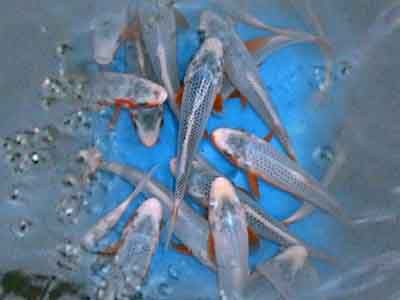
Here are some ideas to keep in mind in the selection process. Asagi Koi gain red year after year. So if you only select tosai that are perfectly marked at one year old, in all likely hood you will end up with a koi that has too much red in the end. The end you say? Well Asagi Koi does not come into its own until the age of three. That’s when the blue back and white fukurin establish themselves. It’s at this time you truly know what you have. So let’s focus on what we can tell with the koi at hand. The easiest job is to take the available koi for inspection and collect them all in a blue bowl. Remove all koi that do not have straight spines and all of their fins. In body shape look for the koi that shows a deeper shoulder than their brothers or sisters. The first thing we look for is white noses. The forehead will be a grey color, but not to worry; by the age of three it will clear up. The area I refer to as the nose is from the end of the mouth back to a line drawn between the two eyes. Return the koi that don’t make this cut.

Next look at the gill cover of Asagi Koi .We want to find red completely encircling the gill cover in what I would describe as a narrow donut affair. If not found look for red at the underside of the gill plate up about a third of the way.

The next critical area of Asagi Koi is the red on the belly.The Japanese refer to this red with a word that translates ship’s red bottom. The appropriate red can best be described as an intense reddish orange. However I have seen blood red and while not the standard still incredibly beautiful! Here’s where it gets difficult. Depending on the breeder and the genes used, you can find red on the belly itself by rolling the tosai over and inspecting underneath or you can see the red already up the sides to the lateral line.

Next, we’re looking at the pecs of Asagi Koi . Back to our perfect world and we spy some that have red that fills the pec one third or half the way thru. This is the best, but again may well be already pulled by the breeder to grow on. So we look for a red pec that may show a tip of white. This is critical for Agasi koi. Not always but most of the time the red will pull back on a full red pec to accomplish what we want by the age of three. If you cannot find one with any white don’t get discouraged it can still happen. Next, let’s look at the tail. If you can find a spot of color on the tail again like the pec with a third to half colored so much the better. If no one has the red in the tail we continue on with a look at the dorsal.

In our perfect world we look for red at the very base not way up high in the fin. Just along the base. If you can find it spaced every so often that is excellent but you may only find this red in one spot closer to the front of the dorsal. If the dorsal is clear, with no red; we’re still in the ball game. Here’s the background for understanding.When the Asagi-han or blue back completes at the age of three and ready for show, here’s some of what the judges are looking for. Red in the tail, dorsal and pecs. This strong show of color is difficult to come by. Because red in the dorsal is a dangerous sign that the koi will complete its red fill-in with more red than wanted. Only a very few select tategoi have red in the dorsal without over running some place else. So if your Asagi completes its pattern and has red about a third in the pec and red in the tail about the same amount and your competition has red only in the pecs, you’ve got the advantage.

Environments For Asagi Koi

A strong GH and your Asagi begins to develop black spots and graying white forehead. Pond readings should be around 7.4 for PH, under 100 for Gh and Kh to suit the needs of our special color variety. Asagi was the first color variety established and all other color varieties were developed from this koi. They tend to be very strong as they are closest to the wild carp. If you feed color food to your baby then you are encouraging the red to aggressively establish.


They will jump and fight you. They are the hardest to handle. Yet in critical shows where everything matters, an Asagi that has popped scales in a struggle and regrows them will exhibit lighter color scales which is a sizeable mark down.


Source :
1. http://www.makc.com/MAKCLIBRARY/Asagi_BenbowWinkler.pdf