
Saturday, August 7, 2010


Monday, August 2, 2010
Injecting Koi Fish

IM is the second choice for injection and is used if the Koi has ulcers that have broken through to the body cavity. Any medication injected into the peritoneal cavity in a fish of this condition could drain out through the ulcer. The draw back to IM is that the muscle tissue of the fish will contract and force some of the injected material to be squeezed back out the injection site. IM can sometimes leave visible welts from trauma to the muscle tissue.
1.Intraperoteneal (IP) Koi Injections
 |
The actual IP injection is performed by injecting in the abdomen at a 45 degree angle between the caudal fins and the anal vent. The needle points towards the head of the fish and enters approximately 2/3 of the way from the anal vent, 1/3 back from the caudal fins (see Drawing 1). Insert the needle quickly, plung smooth but quick, & withdraw the needle. You may fill some resistance from cartlidge below the skins surface. If the fish is large and the cartlidge difficult to penetrate, you can insert the needle slightly to one side of the center line.
You can not avoid hitting a scale, so don’t waist time searching around with the needle. Scales will grow back if lost and since you are injecting on the underside of the fish, any temporary damage will not be visible.
The beauty of the IP injection performed under sedation is that the fish does not thrash about. Without the thrashing, you will not lacerate an organ. In addition, with the fish relaxed & upside down, the organs tend to settle out of the way a bit. You might still puncture an organ, but with the fine needle pushed in and pulled out cleanly, there will be little danger. I have never lost a fish from injecting this method.
2. Intramuscular (IM) Koi Injections
 |
| Intramuscular (IM) Injections |
The IM injection is performed with similar needle angle and direction, but it is in the muscular tissue along and to the side of the dorsal fin (see Drawing 2). With a muscular injection, you must keep the needle in the muscle tissue and press the plunger as you with draw the needle giving room for the fluid to enter. Because of this, the needle must be inserted deeply.
2.1 Dorsal muscle
 |
| Dorsal Muscle Injections |
This injection site offers the opportunity for deep Intra Muscular injections. Slip the needle underneath a scale, aiming towards the nose of the fish and administer the injection. Keep some pressure on the injection site with a thumb for a few seconds to ensure better distribution of the antibiotics and to prevent it from being forced out by contracting muscles. Topical treatment can be applied to the injection site to prevent bacterial infection. Some scales may be lost because of the possibility of a non-contagious cyst that can develop, or a scale that has been pierced will be dislodged when the needle is extracted. This site is risky from an aesthetical point of view and is not recommended for valuable koi.
2.2. Caudal muscle
 |
| Caudal Muscle Injections |
This injection site offers the opportunity for injection into the red muscle of the fish that will ensure rapid distribution of the antibiotics through the fish. The needle is also slipped underneath a scale. The procedure is similar to the injection into the dorsal muscle, and is also not recommended for valuable fish.
2.3. Base of the dorsal fin
The injection site is located at the rear of the dorsal fin, just behind the last fin ray. There are no scales at this site and offers an injection site without the immediate risk of scale losses. If a non-contagious cyst develops, scales may be lost. Insert the needle just behind and slightly to the side if the last fin ray, aiming towards the front of the fish at a 45-degree angle. Because this is also an IM injection, apply a little pressure to the injection site when the needle is withdrawn.
2.4. Pectoral muscle

An injection into the pectoral muscle is the best injection site for an IM injection, mainly because any cysts will be hidden from view and there are no scales. As with all injection sites, this one is also not without risk. Some medications are harsh on muscle tissue and the muscle of a fish may harden, rendering the fin immobile, especially in smaller fish. It however remains the IM injection of choice if the visual damage must remain as little as possible. The accompanying photo demonstrates how the pectoral fin is lifted away from the body exposing the muscle. The injection is administered and the injection site lightly massaged to ensure even distribution of the antibiotic. Topical treatment can also be applied to the injection site to prevent bacterial infection.
The injection site is located at the rear of the dorsal fin, just behind the last fin ray. There are no scales at this site and offers an injection site without the immediate risk of scale losses. If a non-contagious cyst develops, scales may be lost. Insert the needle just behind and slightly to the side if the last fin ray, aiming towards the front of the fish at a 45-degree angle. Because this is also an IM injection, apply a little pressure to the injection site when the needle is withdrawn.
3. Intravenous Koi Injections
Intravenous Injections (IV), Some antibiotics are developed for injection directly into the bloodstream, because it loses it's effectiveness quickly. This can be achieved through an intravenous injection to the base of the caudal fin. The main problem that one experience with this specific injection is the ability to penetrate the vein that runs through the centre of the fish. The best way to determine when the needle is placed correctly is to turn the fish upside down and then to insert the needle at the base of the caudal fin. If you draw the plunger back a little, blood should be entering the syringe. When this happens, the plunger can be depressed and the antibiotic will be deposited into the bloodstream. This should not be attempted unless it is absolutely necessary.
 |
| Intravenous Injections |
Source:
- http://www.lonestarkoi.com/Articles/needles.html
- http://www.koi4u.co.za/index.php?option=com_content&view=article&id=58&Itemid=49
Wednesday, April 14, 2010
Koi Pond With Waterfall

Koi Pond With Wide Waterfall
Although in no approach reduction fantastic than a H2O fountains, waterfalls upon a side or dilemma of a grassed area is located. However, this is wholly unsentimental reasons: a waterfalls, as against to a sources, need walls as a bottom prior to they can operate. Artful raise of stones have been used as a basement for a cases since they used a healthy demeanour add. You have a choice, though if we would have use of fabrication or healthy stones for a waterfall. Who would.

Koi Pond with smooth Waterfall

Waterfall
Source:
1.http://www.homeexteriorinterior.com/backyard-landscaping-ideas-water-fountains-waterfalls-or-garden-ponds/
2. http://fine-fare.blogspot.com/
3.
Tuesday, April 13, 2010
TREATING KOI FISH WITH SALT
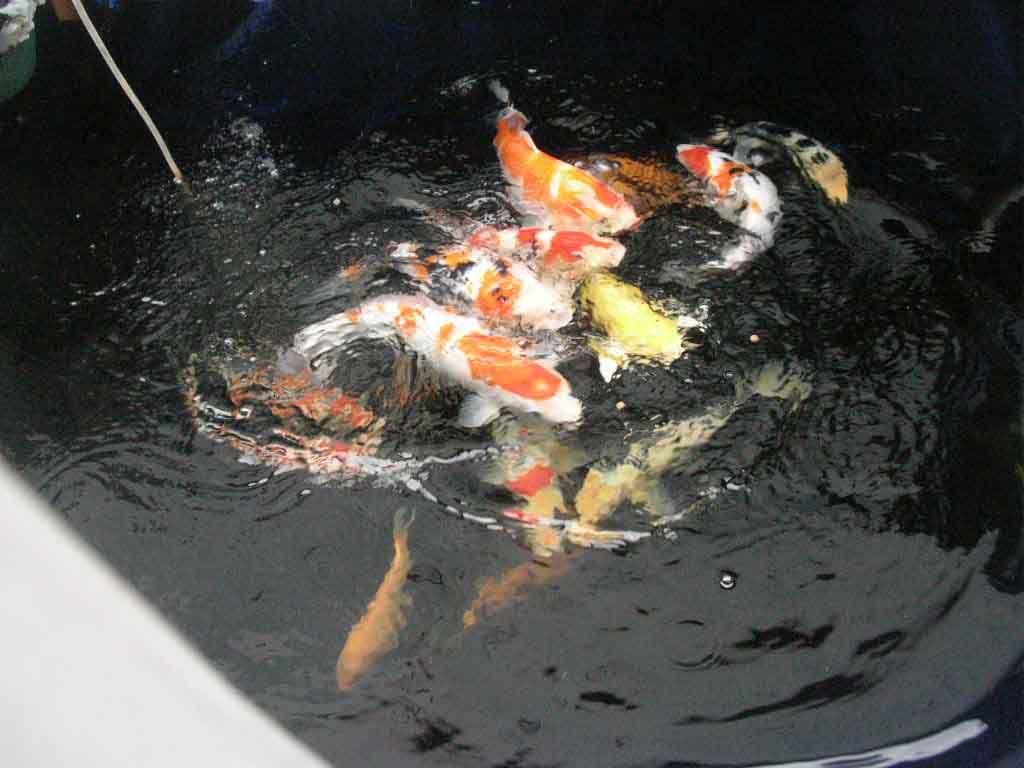
It is far better to add a measure of anesthetic when the Koi has settled down in the bowl and see how the Koi reacts during the next few minutes and if the fish shows no sign of the affects of the anesthetic then add just a little bit more .. Eventually the Koi will lay on its side but at this stage the fish is not completely under the anesthetic and should be left in the solution until the fish can be lifted just clear of the water in your open hand(s) and if the fish then struggles or flaps then place the fish back into the bowl. When it can be lifted out carefully lay the fish on a wet towel ready for treatment. If you are in any doubt then we advise that you seek professional help and guidance.
N.B. Anesthetic's are dangerous and should be handled with the utmost care and placed well out of children's reach when not in use - locked in a medical cabinet if possible. We can supply a completely safe and easy to use anesthetic - see 'Medicine Chest' ...
We do not intend within this first section to discuss the manner to treat the various problems that your Koi may need during their life- but we do discuss this subject elsewhere - but, of course, we are quite willing to try to assist anyone and give our opinion and guidance on the treatment of a particular problem ... please email us if you wish to use this free service ... or seek other professional opinion.
TOPICAL DRESSINGS
Again there are many topical dressings, as such, that can be obtained from a good Koi Dealer who hopefully will give sound advice on their use. Many people use Malachite Green to place on the infected area with reasonably good results. Others may have their own particular brand of dressing that they already use and quite happy with them and we do have a good selection of such dressings and treatments - details of which are all contained within the subject surrounding 'Medications' ... but for those of you who are just starting out in the world of Koi - or you just can't find the right Topical Dressing - then we offer what we consider to be the most effective dressings that we have found to date - the test results that we have run over the past 18 months are conclusive and we wholeheartedly endorse this product and highly recommend it to our many customers. it is ... the KOI DOC Click here
SALT as a Medication:
Salt is probably one of the best forms of pond and water treatment available and at a very minimal cost ... and salt added to any pond or tank at the rate of 1/2 ounce to the gallon is extremely beneficial ... but please seek advice from your Koi Dealer before increasing the dosage rate for whatever reason you may think...
A salt bath is often the cure for many minor problems, like gill infections, raised scales caused by a bacterial infection, ulcers on the body etc .. .and a salt bath cannot do any harm to the Koi providing you don't go over the top with the salt levels ... and depending on the severity of the problem we suggest a salt bath with a level of between 1.5 ounces per gallon to 2.5 ounces per gallon .. but as salt can act as an anesthetic after a period of time, then I suggest that you do not place the Koi into the bowl and walk away - otherwise you may return to find it is too late to recover the Koi ..
BUT if you are using Salt as a Medication Bath then you MUST ensure that there is plenty of air supply in the water - using at least a single 2" air stone - oxygen is extremely important as salt in the water, especially at the higher levels, depletes the oxygen levels very rapidly.
Also NEVER use salt in the water if you have any 'Formalin' present in that water, which you may have been using for other treatments .. many times you may get away with this - but salt reacts with the Formalin and causes stress related problems to the Koi under treatment .. if you are unsure that please contact us for further advise before you use these salt baths or decide to run your system even with the low salt level of 1/2" ounce per gallon ..
Many customers and Koi enthusiasts we know maintain their ponds and tanks constantly at this salt level throughout the year .. others only at certain times of the year. But there is little doubt that a level of salt of 1/2 ounce per gallon is beneficial, and let me stress that Salt will not hurt the Koi at all ... A salt level within the system keeps the gills free from congestion problems which of course is one of the possibly causes of a secondary infection... so I am personally a big advocate for using salt ...
One of the best know treatments for Koi that have been transported for long periods of time, say from a Japan etc .. or from a dealer who may be quite away from you ... and one that we certainly always used upon the arrival of any new stocks from Japan, was to use ELBAGIN AND SALT .. the Elbagin calms the fish down and helps them get over the stress of the journey whilst the salt helps clear congestion from the gills etc
To be able to assess the correct amount per gallon - and to maintain that level - you will need a 'Salt Tester' or a Salt Meter, which will then give you a reasonably accurate dosage rate for salt and enable you to keep that level steady..
It is possible to buy a Salt Tester for a few pounds, but a 'Good' Salt Meter can cost you quite a lot of money - but a simple Salt Tester, which works similar to a hydrometer and will give you the specific gravity.
Please take a look at these Salt Meters if you don't already have one - it will become an important part of your Medical Cabinet - just click on the Product details listed below to see further details on that particular salt meter/tester
Source:
http://www.koicarp.net/koi_medication/treating_koi.html
Subscribe to:
Posts (Atom)