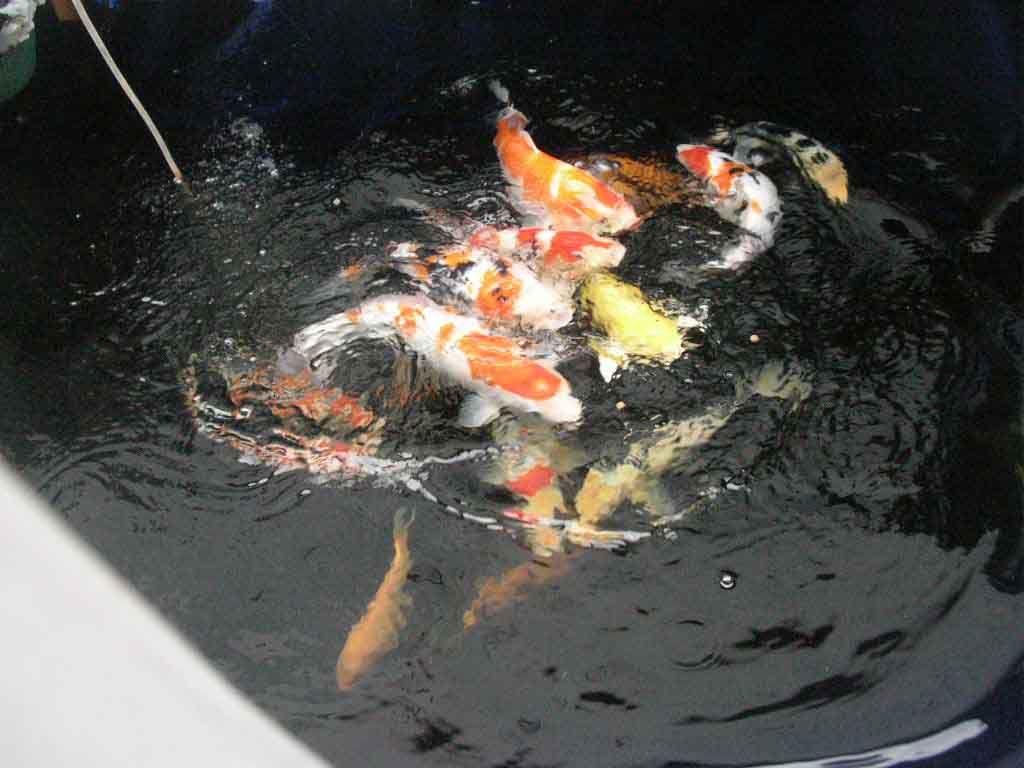
Showing posts with label Koi Care. Show all posts

Tuesday, April 13, 2010

TREATING KOI FISH WITH SALT

When you have selected the correct bowl for the job in hand - always put enough water in the bowl so that the Koi can move freely in the normal upright manner .. then you will need to add some anesthetic - just enough to gently put the Koi to sleep whilst you go to work on the infected, or damaged, area. It is always hard to advise people on how much anesthetic to use ... it depends on many things ... mainly how big the fish to be treated is ... the temperature of the water and how much water is in the bowl ... and how healthy the fish is .... but it is important that you do not put too much anesthetic in the bowl and the fish is almost unconscious as soon as it hits the water ..

It is far better to add a measure of anesthetic when the Koi has settled down in the bowl and see how the Koi reacts during the next few minutes and if the fish shows no sign of the affects of the anesthetic then add just a little bit more .. Eventually the Koi will lay on its side but at this stage the fish is not completely under the anesthetic and should be left in the solution until the fish can be lifted just clear of the water in your open hand(s) and if the fish then struggles or flaps then place the fish back into the bowl. When it can be lifted out carefully lay the fish on a wet towel ready for treatment. If you are in any doubt then we advise that you seek professional help and guidance.

N.B. Anesthetic's are dangerous and should be handled with the utmost care and placed well out of children's reach when not in use - locked in a medical cabinet if possible. We can supply a completely safe and easy to use anesthetic - see 'Medicine Chest' ...

We do not intend within this first section to discuss the manner to treat the various problems that your Koi may need during their life- but we do discuss this subject elsewhere - but, of course, we are quite willing to try to assist anyone and give our opinion and guidance on the treatment of a particular problem ... please email us if you wish to use this free service ... or seek other professional opinion.

TOPICAL DRESSINGS

Again there are many topical dressings, as such, that can be obtained from a good Koi Dealer who hopefully will give sound advice on their use. Many people use Malachite Green to place on the infected area with reasonably good results. Others may have their own particular brand of dressing that they already use and quite happy with them and we do have a good selection of such dressings and treatments - details of which are all contained within the subject surrounding 'Medications' ... but for those of you who are just starting out in the world of Koi - or you just can't find the right Topical Dressing - then we offer what we consider to be the most effective dressings that we have found to date - the test results that we have run over the past 18 months are conclusive and we wholeheartedly endorse this product and highly recommend it to our many customers. it is ... the KOI DOC Click here

SALT as a Medication:

Salt is probably one of the best forms of pond and water treatment available and at a very minimal cost ... and salt added to any pond or tank at the rate of 1/2 ounce to the gallon is extremely beneficial ... but please seek advice from your Koi Dealer before increasing the dosage rate for whatever reason you may think...

A salt bath is often the cure for many minor problems, like gill infections, raised scales caused by a bacterial infection, ulcers on the body etc .. .and a salt bath cannot do any harm to the Koi providing you don't go over the top with the salt levels ... and depending on the severity of the problem we suggest a salt bath with a level of between 1.5 ounces per gallon to 2.5 ounces per gallon .. but as salt can act as an anesthetic after a period of time, then I suggest that you do not place the Koi into the bowl and walk away - otherwise you may return to find it is too late to recover the Koi ..

BUT if you are using Salt as a Medication Bath then you MUST ensure that there is plenty of air supply in the water - using at least a single 2" air stone - oxygen is extremely important as salt in the water, especially at the higher levels, depletes the oxygen levels very rapidly.

Also NEVER use salt in the water if you have any 'Formalin' present in that water, which you may have been using for other treatments .. many times you may get away with this - but salt reacts with the Formalin and causes stress related problems to the Koi under treatment .. if you are unsure that please contact us for further advise before you use these salt baths or decide to run your system even with the low salt level of 1/2" ounce per gallon ..

Many customers and Koi enthusiasts we know maintain their ponds and tanks constantly at this salt level throughout the year .. others only at certain times of the year. But there is little doubt that a level of salt of 1/2 ounce per gallon is beneficial, and let me stress that Salt will not hurt the Koi at all ... A salt level within the system keeps the gills free from congestion problems which of course is one of the possibly causes of a secondary infection... so I am personally a big advocate for using salt ...

One of the best know treatments for Koi that have been transported for long periods of time, say from a Japan etc .. or from a dealer who may be quite away from you ... and one that we certainly always used upon the arrival of any new stocks from Japan, was to use ELBAGIN AND SALT .. the Elbagin calms the fish down and helps them get over the stress of the journey whilst the salt helps clear congestion from the gills etc

To be able to assess the correct amount per gallon - and to maintain that level - you will need a 'Salt Tester' or a Salt Meter, which will then give you a reasonably accurate dosage rate for salt and enable you to keep that level steady..

It is possible to buy a Salt Tester for a few pounds, but a 'Good' Salt Meter can cost you quite a lot of money - but a simple Salt Tester, which works similar to a hydrometer and will give you the specific gravity.

Please take a look at these Salt Meters if you don't already have one - it will become an important part of your Medical Cabinet - just click on the Product details listed below to see further details on that particular salt meter/tester


Source:

http://www.koicarp.net/koi_medication/treating_koi.html

Tuesday, March 30, 2010

Selecting And Culling Koi Fish

Why good Koi Fish are so expensive? The answers because the selection process to obtain good quality of koi is very long and complicated. From thousands of fry only a few are selected to be a good koi fish. Koi that have a standard specification of good koi very rare among thousand of tosai, selected Koi is the best. Breeding Koi starting with selecting good parent of koi, spawning process, and step by step selection and culling process by time and size of koi. The selection process will result koi with variety of quality. Koi with the best quality will be expensive and be winner in koi champion.

Culling Koi Fish

After Growing On in mud pond , tank or aqurium for about three weeks, koi fry start first culling process, remove any larger fry to another tank .The the basic recipe you can follow throughout all the culling procedures are Shape Culling, Color culling and Pattern Culling. Separate Koi fry with the jumbo growth with normal growth, because koi with rapid growth likely to win in food fight. Jumbo Fry become very aggressive especially if sufficient food is not provided. In this condition koi are small in size can not grow well.


Selecting Koi Fish

The first cull happens when the fish are 1 to 2 inches in length where the unmarketable fish are removed. Koi Fry with good color will be selected, then put into grow out ponds where they will continue to grow. Koi that do not pass the selection will be removed.

After an additional 45 days, the previously selected tosai are culled again. These fry are now 3 inches long. This culling is much easier – both because the patterns are much easier to see, and because there are so many fewer individuals to look through.

In an additional 70 days age to 3 months ,Koi Fish selected based on the pattern. Tategoi with the grade A pattern selected and kept again in the pond. This potential koi (tategoi) will keep up to jumbo size and ready to contest. To optimize the growth of Tategoi usually given koi food with Hi Growth type.

Reference :

1. Akca Library

Saturday, March 27, 2010

Prepare A Quarantine Tank For Koi Fish

Ah, yes, the often dismissed but very necessary part of the Koi fish hobby, the infamous quarantine tank. Do you really need one to be successful in this hobby?

For freshwater fish as Koi  you may be able to get by without having one. Freshwater fish are generally more suited to captivity because they are usually tank raised and don't seem to break out in disease as readily as their saltwater counterparts. However, if newly acquired fish do come down with something, you will surely wish that you had one ready to go. One newly bought Koi  fish that is introduced to your main tank can easily wipe out the entire tank population. Better safe than sorry, right?


For saltwater aquarium keepers, I would say that you definitely need a quarantine tank. Marine specimens are mostly wild caught and not used to being kept in captivity. Their journey to a dealers tank is usually much longer and much more stressful for them. Stressed out fish will usually come down with some kind of disease if they don't simply die from the whole ordeal. Saltwater fish keepers will usually have other things in the main display tank such as invertebrates and live rock, that they don't want to expose to the harsh medicines necessary to treat one or two fish. Some medicines can wipe out all of the invertebrates in a tank, so be sure to research any medicine before using it in your tank.

Quarantine Tank Setup
You don't need to go all out here. A simple tank size of 10 - 20 gallons will suffice for most people. If you have larger fish then obviously you want to get a bigger quarantine tank. All you really need is a bare bones setup with the following equipment:

* Some type of filtration (a hang on the back of the tank power filter will work, just use filter floss without the carbon since carbon will remove medication from the water, being counter productive)
* Heater
* A powerhead and/or an airstone for increased surface agitation
* Test Kits for pH, ammonia, nitrite and nitrate
* Fish Net - don't use the same net for your main tank

Fill the quarantine tank with water from the main tank and then turn everything on in the quarantine tank.

Freshwater Fish (Koi Fish) Quarantine

For newly acquired freshwater fish like as Koi Fish you will want to acclimate them to the water in the quarantine tank and monitor them very closely for a period of two to three weeks. Monitor the water parameters with your test kits and check for signs of parasites or bacterial infections.

If the newly acquired Koi fish does come down with something you will need to use the appropriate medication and you will need to keep them in quarantine for a further two weeks to make sure that you have indeed treated them effectively. If after a few weeks no problems develop, you can then acclimate them to the main tank water and then introduce them.

If a Koi  fish comes down with something while in your main tank, just net them and plop them into the quarantine tank. There should be no need to acclimate them because you used water from your main tank. If you didn't use water from the main tank you will need to acclimate them to the quarantine tank water. Diagnose the problem/disease and treat appropriately. After the disease clears up you will still want to keep the fish in quarantine for a week or so monitoring the water parameters with your test kits the whole time.

Saltwater Fish Quarantine
For newly acquired saltwater fish you will want to acclimate them to the water in the quarantine tank and monitor them very closely for a period of two to three weeks. Monitor the water parameters with your test kits and check for signs of parasites or bacterial infections.

If the newly acquired fish does come down with something you will need to use the appropriate medication and you will need to keep them in quarantine for a further two weeks to make sure that you have indeed treated them effectively. If after a few weeks no problems develop, you can then acclimate them to the main tank water and then introduce them.

If a fish comes down with something while in your main tank, just net them and plop them into the quarantine tank. There should be no need to acclimate them because you used water from your main tank. If you didn't use water from the main tank you will need to acclimate them to the quarantine tank water. Diagnose the problem/disease and treat appropriately. After the disease clears up you will still want to keep the fish in quarantine for a week or so monitoring the water parameters with your test kits the whole time.

Always have some extra saltwater ready in case you need to perform an emergency water change. Remember, you want to monitor those water parameters frequently (daily or at least once every two days). Many saltwater hobbyists always have saltwater ready just in case. You never want to mix up saltwater and add it right away. Freshly mixed saltwater can be fairly toxic to fish, in turn causing you more problems.

Conclusion
Freshwater hobbyists may get away with not using a quarantine tank, but saltwater hobbyists would be crazy not using one. Save yourself some money, headaches and especially the fish by having a quarantine tank. The fish in your main tank will thank you for it.

Author Bio
Mike is an editor at FishLore.com. Designed for beginners, FishLore.com provides tropical fish information, how-to guides, articles, fish profiles, FAQs, forums and more! www.FishLore.com - Tropical Fish Information

Article Source: http://www.ArticleGeek.com - Free Website Content

Saturday, November 28, 2009

Koi Growth

Koi is a fish that can reach a large size, more than 1 meter of koi has reached by koi keeper in the world. In addition to the size koi also can reach the old age. Hanako is oldest koi ,was reportedly 226 years old upon her death. She was owned by several individuals, the last of whom was Dr. Komei Koshihara. Her age was determined by removing one of her scales and examining it extensively in 1966. She is (to date) the longest-lived koi fish ever recorded. The growth of koi can be assessed based on comparison of the size and age.

Koi have the potential of growing to an enormous size. Interestingly the size of koi is usually measured in terms of their length whereas anglers measure their prize carp in terms of their weight. Jumbo koi are the product of years of selective husbandry, putting large areas of water in the form of mud ponds to one side for just a handful of prized specimens. In fact, probably the greatest single factor affecting the growth of koi is stocking density, with the largest and fastest growing fish coming form large waters.

Not all koi will have the potential to grow to such large sizes as they will not possess the genetic make up to achieve a jumbo size, irrespective of how ideal the growing conditions, depth of koi Pond,Water quality. In fact there is a general rule when considering the ultimate size of koi. Higher grade, complex variety koi (Gosanke) will not have the potential to reach the same size as the less appealing monocolour koi.

This table shows the size of koi growth based on age, not the absolute value but can be used as comparison. Many Factors that affect koi growth. These are :

a. Genetic/Bloodline.
b. Environment (stocking density, temperature, water quality etc) .
c. Food


MonthsInchesYearsCm
00.30.00.7
11.10.12.9
22.00.25.0
32.80.37.1
43.60.39.1
54.40.411.1
65.10.513.0
75.80.614.8
86.50.716.6
97.20.818.4
107.90.820.1
118.60.921.7
129.21.023.3
139.81.124.9
1410.41.226.4
1511.01.327.9
1611.51.329.3
1712.11.430.7
1812.61.532.1
1913.21.633.4
2013.71.734.7
2114.21.836.0
2214.61.837.2
2315.11.938.4
2415.62.039.5
2516.02.140.6
2616.42.241.7
2716.82.342.8
2817.22.343.8
2917.62.444.8
3018.02.545.8
3118.42.646.7
3218.82.747.6
3319.12.848.5
3419.42.849.4
3519.82.950.2
3620.13.051.1
3720.43.151.9
3820.73.252.6
3921.03.353.4
4021.33.354.1
4121.63.454.8
4221.93.555.5
4322.13.656.2
4422.43.756.9
4522.63.857.5
4622.93.858.1
4723.13.958.7
4823.44.059.3
4923.64.159.9
5023.84.260.4
5124.04.361.0
5224.24.361.5
5324.44.462.0
5424.64.562.5
5524.84.663.0
5625.04.763.5
5725.24.863.9
5825.34.864.4
5925.54.964.8
6025.75.065.2
6125.85.165.6
6226.05.266.0
6326.15.366.4
6426.35.366.8
6526.45.467.2
6626.65.567.5
6726.75.667.9
6826.85.768.2
6927.05.868.5
7027.15.868.8
7127.25.969.1
7227.36.069.4
7327.56.169.7
7427.66.270.0
7527.76.370.3
7627.86.370.6
7727.96.470.8
7828.06.571.1
7928.16.671.3
8028.26.771.6
8128.36.871.8
8228.46.872.0
8328.46.972.2
8428.57.072.5
8528.67.172.7
8628.77.272.9
8728.87.373.1
8828.87.373.3
8928.97.473.4
9029.07.573.6
9129.17.673.8
9229.17.774.0
9329.27.874.1
9429.37.874.3
9529.37.974.5
9629.48.074.6
MonthsInchesYearsCm


Reference:
1. http://en.wikipedia.org/wiki/Koi
2. http://www.pond-doctor.co.uk/
3. http://www.rockymountainkoi.com/

Monday, October 26, 2009

Koi Diseases

Such as human Koi can also get can get sick. The best way to keep a Koi beautiful and healthy is good water quality. Koi diseases easy attack in the dirty water. Good water quality can be obtained by having a good filter system. As the saying goes, an ounce of prevention is equal to a pound of cure. The most common diseases and ailments that can harm a Koi. Koi keepers must be carefull and check Koi health every time. If koi have certain disease usually shows signs of a habbit. Koi keepers must quarantine sick koi from pond and cure them.

ARGULUS

Argulus lice are obvious when they hit. They are greenish, disc shaped parasites that 'suck' onto the fins and sides of the fish. They can cause damage great enough to permit Ulcer formation. They do NOT respond well to Formalin. They DO respond very well, and very quickly to Organophosphates like Fenthion and also Dimilin. Argulus, also known as fish louse or fish lice, is a tiny parasite that posses a crustacean exoskeleton. It has two large circular suckers that it uses to attach to the skin of a Koi. Argulus has a spike that is uses to poke a hole and feed on blood. Argulus is an egg layer, it will lay several hundred eggs on solid surfaces like rock. The eggs have a gestation period of about a month. Argulus take about a month and a half to grow out enough to be able to see. During this time, they will attack any fish or amphibians in the pond. Argulus, like any other parasite, can cause a secondary infection like Aeromonas. Be careful when holding a larger Argulus, it will use its spike to defend itself.
Lernea (Anchor Worm)

Lernea elegans, the most common type of Anchor worm affecting Koi, is a real threat. They attach ventrally, they hold on for about 14 days, and they reproduce copiously. The wounds they create almost always infect with Ulcer diseasse bacteria, Aeromonas, and then you have two problems. Treatment can be undertaken with Malathion, Fenthion, Trichloffon, Dylox, Dimilin, and SALT. Salt works by killing the freeswimming reproductive forms. Malathion just kills the Lernea dead, but is dangerous to the fish. Fenthion is slow but safer Dimilin is great if you can get it EPA and FDA will trounce you for having and using it. I do recommend removing any adults you see attached and swabbing the wounds with Iodine or mercurnchrome. I do recommend also feeding an antibiotic food when you see Lernea to head off problems.
Ichthyophthirius multifilis (Ich, White Spot)

Freshwater Ich causes small white spots all over the fishes body. In some cases, Ich spots may not be grossly visible, but you may see then under the scope. This has to do with a fishes' immune response or lack thereof. The disease is a ciliated protozooan , and it kills smaller fish, while sparing the larger ones. Damage to the gills is the primary way it kills. Its life cycle is roughly 2-5 days, but can be longer (5+ weeks) if the water is cool, much shorter if the water is warmer. To treat, elevate water temps and add salt. Using salt rnay harm plants, so if you are looking for an alternative, I would use Formalin 37% and Malachite Green, applying 1cc Formalin 37% per 10 gallons water every 3rd day after a 30% waterchange. The Malachite green is not that important in this, but would be used to give the Formalin an emerald color. Overdosaing is unlikely with the Malachite fraction, used this way. Three or four treatments covering 10-14 days would be necessary. I always urge people to use salt first. Simply remove the plants and treat them outside the tank with Formalin 2cc per lOgal for 6 hrs before re-adding them to the system, to remove any latent Ich.
Trichodina

This saucer-shaped parasite is over-rated in its pathogenicity allthough, I have seen it cause spiderweb lesions in the skins of Koi. The most serious damage it may do is to the gills of smaller fishes. This is one of one of two or three parasites that causes scratching in Koi, with no serious side effects. The most important thing about Trichodina, is that when it is discovered, it belies a problem in the System Housekeeping department You can bet your license that there is some accumulation somewhere of mulm, and lots of it. TRICHODINA clears easily with SALT, and in very short order. You need only leave salt in for a few days to clear Tricho for good. Here again, if salt cannot or will not be used, Formalin is the next choice.
Gyrodactylus & Dactylogyrus (Skin and Gill Flukes)

Flukes, of the class Gyrodactylus and Dactylogyrus, have long been separated into Skin Flukes, and Gill flukes. There is no need. Because while there are even subdivisions within Gyrodactylus and Dactylogyrus, and they cam be distinguished by their eyespots and Hooks, and embryos; they all die the same. Flukes cause flashing in Koi and other species of fish, more than any other parasite. Rarely fatal to any but the smallest fish, Flukes eat slime and create bleeding microscopic wounds on the gills and skin of fish These wounds can, and often do become infected with Aeromonas bacteria, which is far worse than the original Fluke problem. Their lifespan is roughly 14 days, but they complete a reproductive-maturation cycle in 4 days, and they can be treated with Formalin 37%, Salt, Organophosphates, Droncit (Praziquantel) and Potassium recommend salt first, and if that has not cleared the problem, (as proven microscopically)then use Formalin as a clean up.Formalin as a clean up. Dactylogyrus has eyespots, Gyro does not. Gyro has an embryo inside, Dactylo does not.
Ichthyobodo Necatrix (Costia)

Ichthyobodo necatrix, also known as Costia, is a microscopic protozoan parasite. It causes great harm, it will even kill a Koi if left unchecked. Costia is the hardest parasite to see, for it is one of the smallest parasites that attack Koi. It has a very short life cycle, but it can still be active in cold water. Look for a group of swarming commas on the microscope slide. Costia, like any other parasite, can cause a secondary infection like Aeromonas.
RHABDOVIRVS CARPIO

was reported to be a primary pathogen of cyprinid species, particularly KoI and Carp. The virus causes what the British try to call Spring Viremia of Carp, which is the grossest misnomer; that tries to bundle a multifactorial process involving cold water, depressed immunity, opportunistic pathogenic bacteria, and then, only possibly, a virus like Rhabdovirus carpio; into a simple viral disease. Rhabdovirus carpio has several other names, as several scientists have found the same particle and given it different names. We do know that it can cause swim bladder inflamanation and a reddening disease of the skin called Carp Erythrodertnatitis. You should know that Rhabdovirus carpio, and Spring viremia of Carp, have not been isolated fom any fish on the North American continent, so before you cry VIRUS, read a little. Almost always, Aeromonas bacteria, (and a septicemia from same), are concurrent players witht this virus, and it is hotly debated whether Rhabdovirus carpio can even act alone.
CARP POX

is another virus of a dermatological nature, that also has a low transmissibility from fish to fish, and is again, not fatal, merely disfiguring. The lesions are soft and waxy, not warty and rough. The lesions should not be scraped. They may be differentiated from Lymphocystis because they do NOT cause the cells to become huge (megaloblastic) in size. The way Lymph does. There is no treatment, and lesions do not resolve as well as Lympho lesions do. You should be aware that CARPPOX lesions are very, very rare in North America.
LYMPHOCYSTIS

Of all the viruses affecting Kol, perhaps the most common is LYMPHOCYSTIS. This is a viral pathogen that is poorly transmissible between your specimens. It strikes fish when some damage has occurred to mouth or fin, and sometimes on the body. The lesions are warty and rough. They may be singular or numerous. I see this viral infection in fish in immaculate waters, and so I cannot verify that this is a stress related disease I do know that it is merely disfiguring, not fatal. Lesions may be scraped off; but this could open the skin or fin to bacterial invasion. The only lesions that should be addressed surgically are mouth lesions that interfere with eating. Often, the lesions clear spontaneously, usually, but not always, the SECOND summer after infection, at the peak of the heat. There is a commercial remedy sold for this, but it does not work, and is being sold purely to flim-flam the trusting hobbyist. It is merely acriflavine which is a useless dye.
Ulcer Disease

Ulcer Disease is almost always caused by Aeromonas bacteria or more rarely Pseudomonas bacteria clinically, I wouldn't know which because I rarely culture the pathogen. Why not? Because the results could take a week to return, and by that time, all the affected specimens would be dead. I have treated ulcer disease with the following drugs: Enrofloxacin, Chloramphenicol, Gentamicin, Amikacin, Tetracycline, and recently, Azactam. I inject these drugs. Suffice it to say, that to save these fish, my core recommendations would be to get the fish into a heated environment, provide impeccable water quality, swab the wounds with iodine or Mercurachrome, Feed Romet chow, Inject Enrofloxacin and or Chloramphenicol, and hope that the next spring that the fish does not bloat due to retention of latent bacteria in the kidney after clinical cure.
Scoliosis

Scoliosis is caused by a variety of conditions, none of which is infectious. The most common cause of scoliosis is Vitamin C deficiency. But there are 3 other causes. 2) Tryptophan deficiency: An amino acid protein building block that may be absent in foods due to improper formulation, hyper extended storage, excess heat in processing, or because no variation was permitted in the diet. To avoid this, always use two different high qualtiy staple diets, and supplement periodically with earthworms or other bait worms. Mealworms and crickets may also be accepted, especially if partially crushed. 3) Trauma: The muscles of Koi and other teleost fish are assorted in bands called 'somites'. When a somite is damaged, by intra Muscular injection technique, for example, or a sharp blow, the somite may die, which then shrinks, and kinks the fish, especially when swimming. It may straighten at rest. 4) Organophosphates, like Fenthion, Trichlorfon, or Malathion to name but a few, can cause kinking of the body due to hyper contraction of the muscles. (A side effect of these drugs on the fish is to prevent relaxtion of muscles) and this may kink, or break the fishes back.

Vitamin C deficiencies may be avoided by feeding a varied diet to include the following greens: Spinach, Turnip greens, Broccoli heads, and Dark leaf lettuce. NOT PLAIN LETTUCE!!! Additionally, store no food longer than 90 days, and be sure the label has added ASCORBIC acid. Once scoliosis is noted, the fish is better removed to fresh water, and better attention to diet is advised. As a side note, the biggest, fastest growing fish are most likely to kink, as they need the most Vitamin C and calcium in their diet, to support their rapid growth.
Saprolegnia

Fungal infections of Koi and other ornamental fish are usually caused by Saprnlegnia, a common, if not ubiquitous fingus. Other types include Achlya, Dermatocystidium1 and Branchiomyces. None of the fungal infections I have EVER diagnosed from Koi in 2 years of clinical practice have been anything other than Saprolegnia, and NEVER has Saprolegnia struck where there was not SOME sort of stressor. Surviving 'jumpers', (fish that have cleared the pond and flopped around), are always affected. Healing ulcers often become infected with fungus. The disease looks like cotton-wool protruding from the lesion, and may become stained with algae. Diagnosis is by microscopy, and this is important, as very often, Flexibacter columnaris will look just like this, and it will not respond to anti fungal agents, because IT is a bacteria! Treatment of fungal infections is only possible where immaculate water quality and good diet prevails. Then, a variety of drugs are effective, to include my favorite, Methylene Blue. Formalin is effective but only worsens stress on the fish. Malachite green can be swabbed on fungal lesions if the specimen can easily be captured daily. Potassium permanganate effectively kills fungi, perhaps better than anything, but this is a VERY dangerous drug to use on fish, unless you have great experience and don't mind a risk.
Dropsey/Bloater

Dropsy, also known as Bloater or Pinecone disease, is usually caused by bacterial invasion of the fishes' kidney. A herpes virus may also contribute. There is a sporozooan parasite that can damage the Kidney this way, called Mitraspora cyprini, but I have yet to see this on a necropsy. Dropsy is, for all intents and purposes, untreatable, based on 2 years experience, using the following drugs: Azactarn, Baytril, Chloramphenicol, Gentamicin, and Amikacin. I have tried a Sulfa drug, brand name Albon, and that did not resolve the problem either. Bacterial dropsy is usually caused by Aeromonas or Pseudomonas bacteria. I have also seen cases infected with Mycobacteria. By the time and the scales protrude form the body, the damage to the kidney is so profound that recovery is impossible. If you must try to save the fish, isolate the specimen, elevate temps while elevating oxygenation, and begin injecting antibiotics intraperitoneally. You could also feed the antibiotics in a medicated feed.
OODINIUM

Oodinium is the causative agent in Velvet disease. This pearshaped sessile organism gives a velvety, gold dust look to affected Kol. It is reported that this may not clear with Salt, but I have yet to see this type of resistance. If it didn'tclear with Salt, I would use Formalin. I have only encountered Velvet/Oodinium very rarely in Koi. It would be more common in freshwater aquariums or on recently purchased Goldfish.
CHILODINELLA

Chilodinella is one of the hottest fish killers there is. Under the scope you may see a beanshaped organism, or a large round organism full of tiny bubbles. Alive, the Chilodinella resembles a heart shaped onion with a flizzy end where you could imagine the onions roots would be. These are actually cilia. Dead, Chilodinella are motionless round balls full of tiny bubbles. They may resemble Ich but they do not have crescent nucleus nor do they move in their dead, rounded state. Chilodinella clears EASILY with salt. Leave the salt in for 14 days, and be sure to supplement aeration, as gill damage from Chilodinella may be severe in the survivors Chilodinella should be suspected anytime large numbers of fish are dying on the surface or who roll over on their sides except when disturbed, the Koi dash madly.

Reference:
1.Nishikigoi Info
2. Dr Eric Johnson DVM, AKCA Library