Showing posts with label Koi Pond Filter. Show all posts

Thursday, November 26, 2009

Aeration System For Koi Pond

More fish die from a lack of oxygen than any other cause. To be educated fish keepers we must have a clear understanding of oxygen. We need to know what takes oxygen out of the water and how to put it back.

Oxygen Basics
You and I, your cat, and your canary all breathe air containing 20.9% oxygen, whereas your fish breathe water containing 0.0008% oxygen! They have evolved to be comfortable with that amount, but at 1/2 that amount, 0.0004%, they are hurting!

In garden ponds, we typically see oxygen problems only during the summer because when the water is warm all those things which consume oxygen speed up increasing their consumption of oxygen. For every 10C there is an approximate doubling of the consumption of oxygen (and production of carbon dioxide). Your fish may be happy and healthy at 20C (68F) and suffering from low oxygen stress at 30C (86F) in the same pond.

Oxygen levels can only be determined by measurement with a test kit or an oxygen meter. Submerged plants and algae take oxygen out of the water at night. Their effect can be significant when you have "green water" (phytoplankton algae and zooplankton).

Oxygen Levels

* Warm water saturation is about 8 ppm
* Continuous healthy minimum is about 6 ppm
* Low level stress and poor feeding response 4-5 ppm
* Acute stress, no feeding, inactivity 2-4 ppm
* Death 1-2 ppm

The above is a guideline only, as duration, water quality, condition of fish, level of other gasses, etc. All have a significant effect.

Low Oxygen Stress
It is important to know you have an oxygen problem long before your fish start dying. You need to either monitor it by periodically measuring it when you expect it to be low or, select and use an aerator large enough to handle the summer time conditions.

If you are stressing your fish, you are making them much more vulnerable to disease, parasites and infection. Their activity level will be reduced as well as their growth rate. Low oxygen levels will lower the oxidation/reduction potential (ORP), favor growth of disease causing pathogens and disrupt the function of your biofilter.

Solution
You can either design and maintain your pond so that oxygen never becomes a problem, i.e., clear water, few fish, little food and clean bottom. Perhaps, use an aerator, at least during the warm periods. Since every pond is unique and conditions, especially water quality and fish quantity vary greatly, I can only give you general guidelines (see oxygen budget). If you are not sure - measure the oxvgen level. Buy or borrow a dissolved oxygen test kit or an oxygen meter. Use it along with your preferred aerator until you are sure that the oxygen level will be maintained.

Aeration
Most fish keepers know they need some type of aeration. But, unless you've studied this science (and who has?) you are probably assuming that your stream, venturi, waterfall, air diffuser or fountain is taking care of your aeration needs. They may be, but are your sure? Almost anything that assists the transfer of oxygen into water could be called an aerator. But, is the aeration effect significant and is the energy expended cost effective? The oxygen content in your pond depends upon the rate of consumption vs the rate of replacement.

Oxygen Budget
The need for more oxygen comes from fish, plant respiration, the chemical and bacterial decomposition of waste matter. If you really want to read the numbers, read the following. Theoretical oxygen budget for a 1.000 gllon (3.800 liter) pond.

1,000 gallons of water at 6 ppm contains about 24 grams of oxygen. 10 lbs. of fish need about 18 grams of oxygen per hour. 1,000 gallons of water with a chlorophyll A of 20 mg/l (light green water), a B.O.D. of 10 mg/l (uneaten food, bacteria, etc.) will consume about 2 grams per hour. Feeding 3% of the fish's body weight per day will add 60 grams of food which contains 24 grams of protein, which converts to about 2 grams of ammonia, which will consume about 14 grams of oxygen in the biofilter. Pollen, bird droppings, leaves, etc. may add 2 more grams. 36 divided by 24 equals 1.5 grams per hour.

This example shows the fish consuming the most oxygen and the biofilter the 2nd largest amount, but be aware that very green water can cause a fish kill in a stagnant, nonaerated pond even if it contains only very few fish!

If you had an aerator maintaining the oxygen level at 6 ppm and you turned it off at 8:00PM, you would lose about 6% (1.5 grams) of the pond's oxygen per hour. By 8:00 AM, the next morning, the oxygen level could be as low as 1 ppm. If your aerator is your fountain, do not turn it off at night.

Aerator Performance
Following is a list of typical Koi pond aerators with estimates of oxygen transfer performance and efficiency. (Assumes 3000, clean water, 70% of saturation, power cost $0.1 0/kwh.)


AeratorFlow rateWatts usedGrams O2 per hourCost per 100 grams
Lazy Stream 12" drop10gpm 150watts 1.2$1.26
Babbling Stream 12" drop 10 gpm 150 2.4 .63
Waterfall 12" drop straigh into pond 10gpm 150 1.4 1.05
Waterfall 2-24" drop fallng on rocks10 gpm 200 3.1.65
Fountain5 gpm 100 1.6 .63
water pump with venturi4 gpm 1004.0 .25
Air compressor linear type 1 1 cfm30 4 $0.06


Summary
Make sure that your fish are not being stressed. If your fish are valuable to you, it is cheap insurance to have two aerators or separate breakers. If one fails, the other will prevent severe fish stress or mortality.

If you are building a pond, design it so you never have to worry about oxygen. Wire it so that your water pump and aerator are served by separate breakers, select energy efficient long life components. Consider that someday you will have a lot of fish, lots of algae, warm water and a broken pump.

Oxygen is the first miting factor in water quality. Ammonia and nitrite take days to reach crisis levels. Oxygen can become critical in a few hours.

Source : http://akca.org/library/aerate.htm
Thursday, November 5, 2009

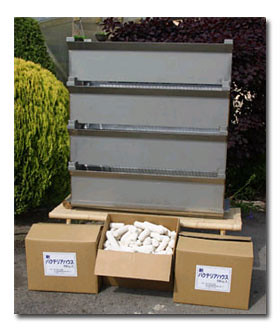
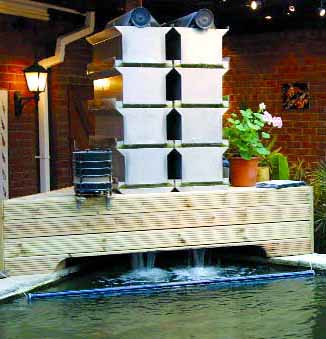
Koi Pond Filter With Bakki Shower

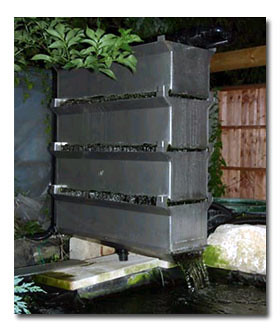
Bakki Shower Bakki Shower filter media was originally conceived by MTK in Japan, for treating effluent water, some 8 years ago, and went on to win an International award in Germany, as "Best filtration media in the World." Mr. Mannami of MTK is a close friend of President Maeda of Momotaro Koi Farm. Mr. Maeda has long been fascinated by the way that water becomes 'alive' as it tumbles over rocks in the Asahi River outside his Koi Farm. As such, he was convinced that it would be possible to make much better water for koi, just by recreating the effects of the tumbling river.


So, with this fascination, he set about having the stainless steel shower trays made, in order that he could try out 10 test ponds with every kind of media that was available, in both showered form, and submerged form. First tests with the original form of 'Bacteria House' were very good, but Mr. Maeda wanted more from the media! Research was carried out into the effect of 'Far-infrared radiation' because of a famous Japanese spring, which was said to have healing effects. The key to this spring's wonderful water was the Bakuhenseki stone, through which the water permeated. The Bakuhenseki stone emitted these 'Farinfrared rays' which had an effect of refreshing, or activating the water. In short, Mr.Maeda wanted to achieve the same effect as this spring, but on a higher level.

Bakki Shower Koi Pond Filter


Further research and development between Mr.Mannami, and Mr. Maeda, led on to a second, and then third generation of Bacteria House. This third (and final) generation encompassed Mr. Maeda's aims. It created a higher intensity of 'Far-infrared', and was significantly more robust than the first and second generations. Momotaro Koi Farm carried out extensive 'real world' testing of Bacteria House, in both submerged and showered filtration, while MTK carried out all of the scientific research, using their three showered test ponds. Testing at Momotaro Koi farm was carried out in order to find out which media created the best water for the growth and development of koi. On the 10 test ponds, they tried every single type of media that was available, and compared the results that were achieved with the koi in each system. It was found that 'Bacteria House' performed better than any other media in submerged use, but in the Bakki Showers, it was the only media that worked, and that it far outperformed any other configuration.

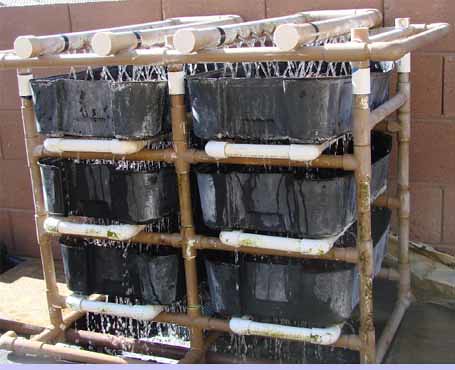
Bakki Shower Koi Pond Filter


MTK researched which strains of bacteria colonized on each material, and also paid particular attention to bacterial counts, and colonization times. Periodically, a sample of each media was sent to the lab to analyze its cross-section. It was essential that Bacteria House encouraged the right strains of bacteria, and in desirable ratios. It was also essential to make sure that it
colonized very quickly, and recovered quickly from chemical treatments and power failures. In addition to every available type of filter material, they also tried many different blends and forms of Bacteria House. This testing spanned not weeks or months, but several years!

DIY Bakki Shower


The Advantages of Bakki Showers
- maintenance free
- complete bio-filtration, including nitrates
- extremely fast to mature
- excellent water clarity
- huge oxygenation
- far infra-red' rays have an effect of freshening water, and deodorizing
- space saving design means that [the filtration for] a pond of 10,000 gallons can occupy the space of a conventional 6000 gallon pond most Bakki Showered ponds will run without the need for a U/V
- fast recovery following power cuts. Won't become oxygen starved like a conventional filter
- Bacteria House won't wear away, block, or need replacing

Source :

http://www.makc.com
http://www.momotaro-koi.org
http://www.absolute-koi.com

Monday, June 29, 2009

Green Water Problem

Green water in the koi pond is the scourge of outdoor pond owners. Green water is caused by a population explosion of algae in the koi pond. Algae are microscopic, single-celled plants, which can easily multiply to a density of as much as 7,000-15,000 per milliliter. With that many of them in the water, it's no wonder that the water turns green. Koi ponds can get high concentrations of phosphates from food decomposition, and nitrates from the nitrification cycle. High concentrations of phosphates and nitrates are the food for pond algae, along with some iron as a catalyst. So high ammonia in the koi pond will make koi pond green.


Green water in the koi pond can't reduce with mechanical filtration because size of algae very small. The ideal conditions for algae to grow rapidly in number are:
1. Warm water pond, Algae grow well in warm temperatures. In warm temperature water in the koi pond potential to become green.
2. Well-lighted water, plant (algae) photosynthesis need Sunlight.
3. An abundance of nutrients.
4. Koi Feces produce amonia.

If whole or part of condition is fulfilled, algae in the koi pond grow well and water become green.

The key to 'clearing up' green water, therefore, is to prevent the algae from multiplying by removing the ideal conditions for their growth.
Algae Control in The Koi Pond

We Can Control Algae in the koi pond with several way. We Can choose proper way or combination of way. Follow the way to reduce green water in the koi pond :

1. Shade The Pond
Warmth of the water and the availability of light for photosynthesis is modulated by sunlight. Shade the pond will reduce sunlight in the pond. If koi pond shade sunligt can't access pond and algae can't grow well.

2. Remove sources of organic matter.
Removing all harmful compounds from the pond water is proper water filtration. Physically Filtration removes most of the decaying organic matter in the pond. Koi Pond filter must have a water capacity of no less than 10% of Koi pond volume and filter pump must be capable of turning over the entire volume of your pond in one hour. Idealy Filter must 30% of koi pond volume.

3. Remove Koi Feces from the pond.
Koi Feces produce ammonia, Ammonia and nitrites are extremely harmful, and even deadly to koi. Remove koi feces will reduce disolved ammonia in the koi pond. Remove Koi Feces can do with good filtration system.

In Biological filter chamber Certain bacteria convert these ammonia into nitrites, which are further converted by other bacteria into nitrates. Nitrates are less harmful than these two, but they are powerful fertilizers for all plants in the pond, including algae. Coupled with warm water, a suitable pH, carbonate hardness, and the presence of other nutrients like phosphates, nitrates are a sure-fire way of multiplying algae in large numbers.

4. Give Water Cleaner
Water Cleaner use chemical method to control algae. Chemical control usually means the use of algaecides, a chemical which kills or inhibits all types of algae to a greater or lessor degree. Water cleaner can remove green water in the koi pond in short times. Caution must be exercised with these chemicals as overdosing can kill fish.

5. Put other plants in the pond/Filter
Many plants have voracious appetites for pond water nutrients, so having them in the Koi pond will deprive the algae of nutrients.

6. Install UV (Ultra Violet ) system
Ultraviolet lamp systems designed to kill algae and make them clump together. You can put the uv lamp assembly before your main filter, so that the dead algae will not be returned to the koi pond. Ultraviolet systems will effectively kill planktonic algae with the proper size unit for koi pond. UV effectively eliminate green water in the koi pond in a short time.

7. Change Partial Water regulary.

Change 10-30% water regulary, if needed you can change everyday. If not you can change water pond every week.

Theese step can reduce and remove green water in your pond.

Reference:

- Laguna Koi
- KoiAndPond